
Best Carbon Monoxide Detectors for Aircraft (2026): Portable and Built-In
The best aircraft CO detector: Sensorcon's AV8 Inspector, Forensics Detectors' meters, and CO alarms built into ForeFlight's Sentry and Lightspeed's Delta Zulu.
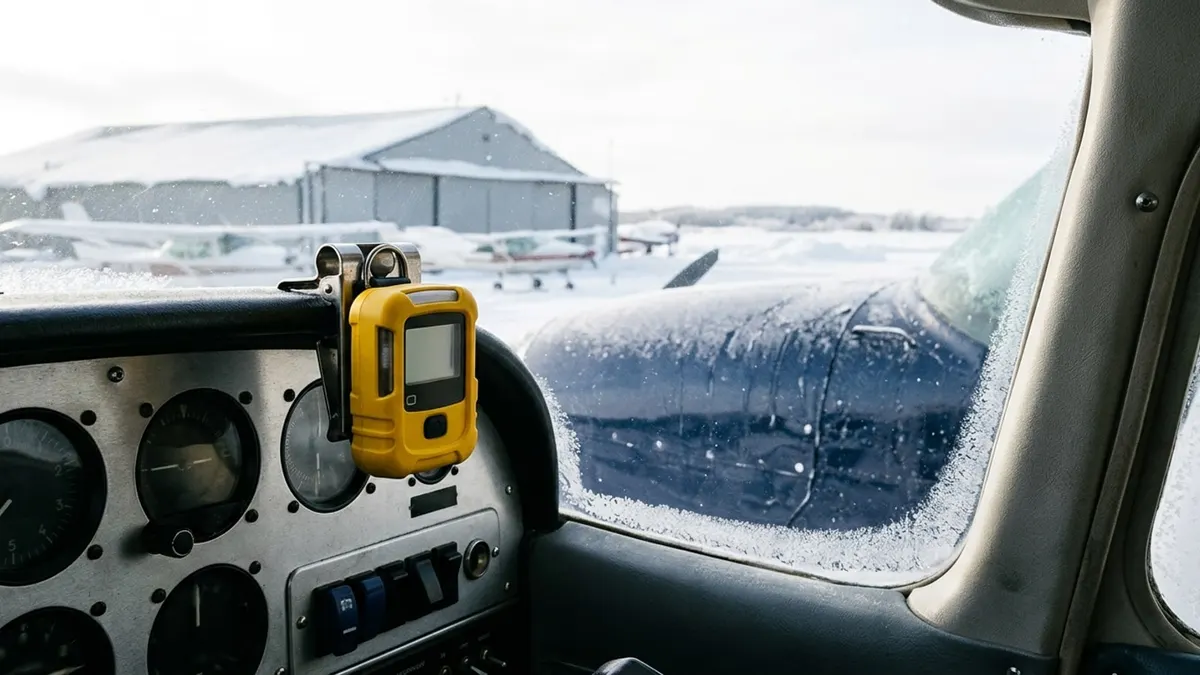
Affiliate disclosure: product links on this page go to Amazon or to the maker's own store. As an Amazon Associate we earn from qualifying purchases, at no extra cost to you; links to makers' own stores earn us nothing. No retailer or brand sees our picks before they are published or has any say in them. How we choose.
Every piston airplane with exhaust-heated cabin air should carry a carbon monoxide detector that beeps and flashes. That is the NTSB's advice in its 2017 safety alert for pilots, which notes that many piston airplanes heat the cabin with air warmed around the exhaust, that a crack in the muffler can put CO into the cockpit, and that panel-mounted detectors with aural alerts and a flash notification are more likely to get your attention.
For a standalone detector made for aircraft, the Sensorcon AV8 Inspector reads 0 to 500 ppm, has audible and visual alarms, an optional panel mount and a two-year battery (per Sensorcon's Amazon listing). If you already fly with a ForeFlight Sentry or Sentry Plus, or want it in your headset with Lightspeed's Delta Zulu, the CO alarm can come built in.
Our top picks at a glance
1. Best standalone
Sensorcon AV8 Inspector aviation CO monitorType: Portable, digital, aviation model · Alarm: Audible and visual · Range: 0 to 500 ppm · Power: CR123A, 2+ years
2. Best in a headset
Lightspeed Delta Zulu (GA dual plug)Type: ANR headset with CO sensor · Alarm: Audible and visual at preset levels · Range: Not listed · Power: Headset batteries
3. Best two-in-one
ForeFlight SentryType: ADS-B receiver with CO monitor · Alarm: CO monitor and alarm · Range: Not published on the comparison page · Power: 12 h internal battery (Plus: 18 h)
4. Best no-maintenance budget
Forensics Detectors FD-101 CO detector (2-year disposable)Type: Portable, disposable · Alarm: Buzzer, LED and vibration · Range: 0 to 1,000 ppm · Power: 2-year sealed battery
5. Best rechargeable budget
Forensics Detectors FD-90A CO meter (rechargeable)Type: Portable, rechargeable · Alarm: Adjustable audio, visual and vibration · Range: 0 to 1,000 ppm · Power: 1,500 mAh Li-ion, micro-USB
| Pick | Type | Alarm | Range | Power | Buy |
|---|---|---|---|---|---|
| Sensorcon AV8 Inspector aviation CO monitorBest standalone | Portable, digital, aviation model | Audible and visual | 0 to 500 ppm | CR123A, 2+ years | Amazon |
| Lightspeed Delta Zulu (GA dual plug)Best in a headset | ANR headset with CO sensor | Audible and visual at preset levels | Not listed | Headset batteries | Amazon |
| ForeFlight SentryBest two-in-one | ADS-B receiver with CO monitor | CO monitor and alarm | Not published on the comparison page | 12 h internal battery (Plus: 18 h) | ForeFlight |
| Forensics Detectors FD-101 CO detector (2-year disposable)Best no-maintenance budget | Portable, disposable | Buzzer, LED and vibration | 0 to 1,000 ppm | 2-year sealed battery | Amazon |
| Forensics Detectors FD-90A CO meter (rechargeable)Best rechargeable budget | Portable, rechargeable | Adjustable audio, visual and vibration | 0 to 1,000 ppm | 1,500 mAh Li-ion, micro-USB | Amazon |
Best standalone
Sensorcon AV8 Inspector aviation CO monitor
A dedicated aviation CO monitor with a digital reading and an optional panel mount.
- Type
- Portable, digital, aviation model
- Alarm
- Audible and visual
- Range
- 0 to 500 ppm
- Power
- CR123A, 2+ years
Pros
- Made for cockpit use, with an optional panel mount (sold separately)
- IP67 waterproof and shockproof housing
- Two-year warranty (per the Amazon listing)
Cons
- Not a TSO'd installed detector
Sensorcon's AV8 Inspector is the aviation version of its industrial CO monitor: real-time readings from 0 to 500 ppm, audible and visual notification, a steel clip and lanyard loop, an optional removable panel mount, an IP67 housing and a CR123A battery rated for two or more years of normal use, with a two-year warranty, per Sensorcon's listing. Mount it on the panel where you will see it, as the NTSB recommends.
Best in a headset
Lightspeed Delta Zulu (GA dual plug)
Lightspeed's flagship ANR headset with a CO sensor that alerts you in your ears.
- Type
- ANR headset with CO sensor
- Alarm
- Audible and visual at preset levels
- Range
- Not listed
- Power
- Headset batteries
Pros
- An alert you hear even with your eyes outside
- Seven-year warranty, per Lightspeed
- App shows CO levels
Cons
- The most expensive way to get a CO alarm
- Only protects the person wearing it
The Delta Zulu's listing describes built-in Kanari CO technology that measures cabin carbon monoxide and gives audible and visual warnings at preset thresholds, with levels shown in Lightspeed's app. Lightspeed covers the Delta Zulu for seven years. It makes sense if you were buying a premium headset anyway; see the best aviation headsets.
Best two-in-one
ForeFlight Sentry
If you want an ADS-B receiver anyway, the standard Sentry and Sentry Plus include a CO monitor and alarm.
- Type
- ADS-B receiver with CO monitor
- Alarm
- CO monitor and alarm
- Range
- Not published on the comparison page
- Power
- 12 h internal battery (Plus: 18 h)
Pros
- One device on the glareshield for traffic, weather, backup attitude and CO
- $649 from ForeFlight; Sentry Plus $799
Cons
- Works with ForeFlight and OzRunways only
- Sold by ForeFlight, not Amazon; this link earns us nothing
ForeFlight's comparison table lists a CO monitor and alarm on the standard Sentry and the Sentry Plus (not on the Sentry Mini), alongside dual-band ADS-B, FIS-B weather, GPS and backup attitude. If you already use ForeFlight, it is the simplest way to put a CO alarm in the cockpit. See Sentry Plus vs Sentry Mini.
Best no-maintenance budget
Forensics Detectors FD-101 CO detector (2-year disposable)
A sealed, drop-tested CO detector with a two-year life, for the flight bag or a rental airplane.
- Type
- Portable, disposable
- Alarm
- Buzzer, LED and vibration
- Range
- 0 to 1,000 ppm
- Power
- 2-year sealed battery
Pros
- Vibration alarm you can feel through a pocket
- IP67, passes a 10 ft drop test (per the listing)
- Arrives with a NIST calibration certificate
Cons
- Industrial product, not made for aircraft
- Replace the whole unit after two years
Forensics Detectors' FD-101 is an industrial CO detector: 0 to 1,000 ppm with an electrochemical sensor, buzzer, LED and vibration alarms, a sealed two-year battery, IP67 and a 10-foot drop test, with a NIST calibration certificate and a one-year warranty, per the listing. It is the low-effort option to carry into a rented airplane.
Best rechargeable budget
Forensics Detectors FD-90A CO meter (rechargeable)
A rechargeable CO meter with adjustable alarms, for pilots who prefer USB charging.
- Type
- Portable, rechargeable
- Alarm
- Adjustable audio, visual and vibration
- Range
- 0 to 1,000 ppm
- Power
- 1,500 mAh Li-ion, micro-USB
Pros
- Adjustable alarm levels
- Response time under 30 seconds (per the listing)
- Rechargeable
Cons
- Must be kept charged
- Industrial product, not made for aircraft
The FD-90A is Forensics Detectors' rechargeable CO meter: 0 to 1,000 ppm, an electrochemical sensor with error better than plus or minus 5% of full scale and a response time under 30 seconds, adjustable audio, visual and vibration alarms, and a 1,500 mAh battery charged over micro-USB, per the listing. Charge it with your iPad before each flight.
Why every piston airplane needs one
The NTSB's Safety Alert 069 (September 2017) calls the risk of CO poisoning "overlooked and underestimated." Carbon monoxide is colorless, odorless and tasteless. Many piston airplanes heat the cabin by passing air around the exhaust inside a heater shroud, so a crack in the muffler or exhaust can put CO into the cabin. Early symptoms are vague (headache, nausea, drowsiness), and pilots often do not connect them with CO. The alert describes accidents in which pilots were incapacitated, including a Mooney pilot whose airplane flew on for about 1.5 hours after he lost consciousness, and whose muffler was found fractured.
What the NTSB recommends
- Install a CO detector, and replace the device and its batteries as its maker directs.
- Prefer a detector mounted on the instrument panel with aural alerts and a flash notification.
- Have exhaust systems, air ducting, firewalls and door and window seals inspected at every annual or 100-hour inspection.
- On preflight, check the exhaust for cracks at the muffler ends and soot on the shroud; if you see soot or signs of exhaust flame, do not fly until a mechanic has looked.
- If you suspect CO in flight: open windows, turn off the heat, land as soon as practical and get medical attention.
How much CO is too much
The NTSB's alert gives blood levels, not cabin readings. It says carbon monoxide levels in the blood between 10% and 20% can cause confusion, impaired judgment and difficulty concentrating, and the pilots in the four accidents it describes measured 21%, at least 28%, 37% and 48%. Three of the four accidents were fatal, and in three of them investigators found cracks or a fracture in the muffler.
For cabin air, the FAA's standard for transport airplanes, 14 CFR 25.831, treats carbon monoxide above 1 part in 20,000 parts of air as hazardous. That is 50 parts per million (our arithmetic), a number you can hold against a detector's alarm thresholds. The rule is written for certifying airliners, not for your airplane, so use it as a yardstick.
Lycoming's cold-weather guidance adds the maintenance side: have the heating system checked for leaks as part of regular maintenance, because you cannot smell carbon monoxide. The AIM notes that CO from exhaust fumes also impairs night vision.
Choosing a detector
Active alarm, not a color spot
Passive color-change cards only work if you look at them. The NTSB's point is that an alarm that sounds and flashes is more likely to get your attention. Every pick here has an active alarm.
Mounting
Put the detector where you will see it: on the panel or glareshield, not in a bag. The Sensorcon has an optional panel mount; the Sentry sits on the glareshield or window; the Delta Zulu alerts in your ears.
Sensor life
Electrochemical CO sensors wear out. Follow the maker's replacement date: the Forensics FD-101 is sealed for two years, and the Sensorcon's battery is rated for two years or more.
How the picks compare
| Detector | Type | Alarm | Made for aircraft |
|---|---|---|---|
| Sensorcon AV8 Inspector | Standalone | Audible, visual | Yes |
| ForeFlight Sentry / Sentry Plus | In ADS-B receiver | CO alarm | Yes |
| Lightspeed Delta Zulu | In headset | Audible, visual | Yes |
| Forensics FD-101 | Standalone, sealed | Buzzer, LED, vibration | No (industrial) |
| Forensics FD-90A | Standalone, rechargeable | Audio, visual, vibration | No (industrial) |
Flying high as well as in winter? Hypoxia and CO poisoning share symptoms; see our portable oxygen and pulse oximeter guide and the FAA oxygen rules calculator. Flying over remote country? Carry a personal locator beacon. Winter also means preheating: see the engine preheater guide.
Frequently asked questions
Do I need a carbon monoxide detector in my airplane?
It is not required for most general aviation airplanes, but the NTSB recommends one in its Safety Alert 069, because many piston airplanes heat the cabin with air warmed around the exhaust and a cracked muffler can put CO into the cockpit.
What kind of CO detector is best for aircraft?
One with an active alarm. The NTSB says detectors mounted on the instrument panel with aural alerts and a flash notification are more likely to draw your attention than passive indicators.
Does the ForeFlight Sentry detect carbon monoxide?
The standard Sentry and the Sentry Plus include a CO monitor and alarm, per ForeFlight. The Sentry Mini does not.
What are the symptoms of carbon monoxide poisoning in flight?
The NTSB lists headache, drowsiness, nausea and shortness of breath, and warns that early symptoms are vague and easy to dismiss. Impaired judgment, disorientation and dizziness follow.
What should I do if my CO detector alarms in flight?
The NTSB says open the windows, turn off the cabin heat, land as soon as practical and seek emergency medical attention.
Can I use a home CO detector in my airplane?
Home alarms are designed for houses, not cockpits. A portable detector with a digital reading and an active alarm, mounted where you can see it, is a better fit for a cockpit.
Sources
- Safety Alert 069: Pilots: Prevent Carbon Monoxide Poisoning, National Transportation Safety Board
- Sentry: The Next Generation of ADS-B Receivers (model comparison), ForeFlight
- What's Included With A Lightspeed Warranty?, Lightspeed Aviation
- 14 CFR 25.831, Ventilation, Legal Information Institute
- Operating in Cold Weather, Lycoming
- Aeronautical Information Manual, Chapter 8 Section 1 (8-1-2 and 8-1-6), Federal Aviation Administration
Cover image: Illustration: Aviation Gear Review (AI-generated)
Related guides
Best Personal Locator Beacons for Pilots (2026): ACR and Ocean Signal
A PLB in your pocket goes with you if you leave the airplane. Four 406 MHz beacons compared, and what the ELT rule does and does not cover.
Best Red Flashlights and Headlamps for Pilots (2026)
Red light protects night vision but distorts chart colors, so the FAA says keep white light available too. Five lights that do both.
Portable Aviation Oxygen: When You Need It, Pulse-Demand Systems and Oximeters
The FAA's rule and its stricter recommendation, how a pulse-demand system stretches a cylinder, and where a fingertip pulse oximeter fits in.