
Portable Aviation Oxygen: When You Need It, Pulse-Demand Systems and Oximeters
Portable aviation oxygen explained: when 14 CFR 91.211 and the AIM say to use it, how pulse-demand systems like Mountain High's O2D2 work, and pulse oximeters.
Affiliate disclosure: product links on this page go to Amazon or to the maker's own store. As an Amazon Associate we earn from qualifying purchases, at no extra cost to you; links to makers' own stores earn us nothing. No retailer or brand sees our picks before they are published or has any say in them. How we choose.
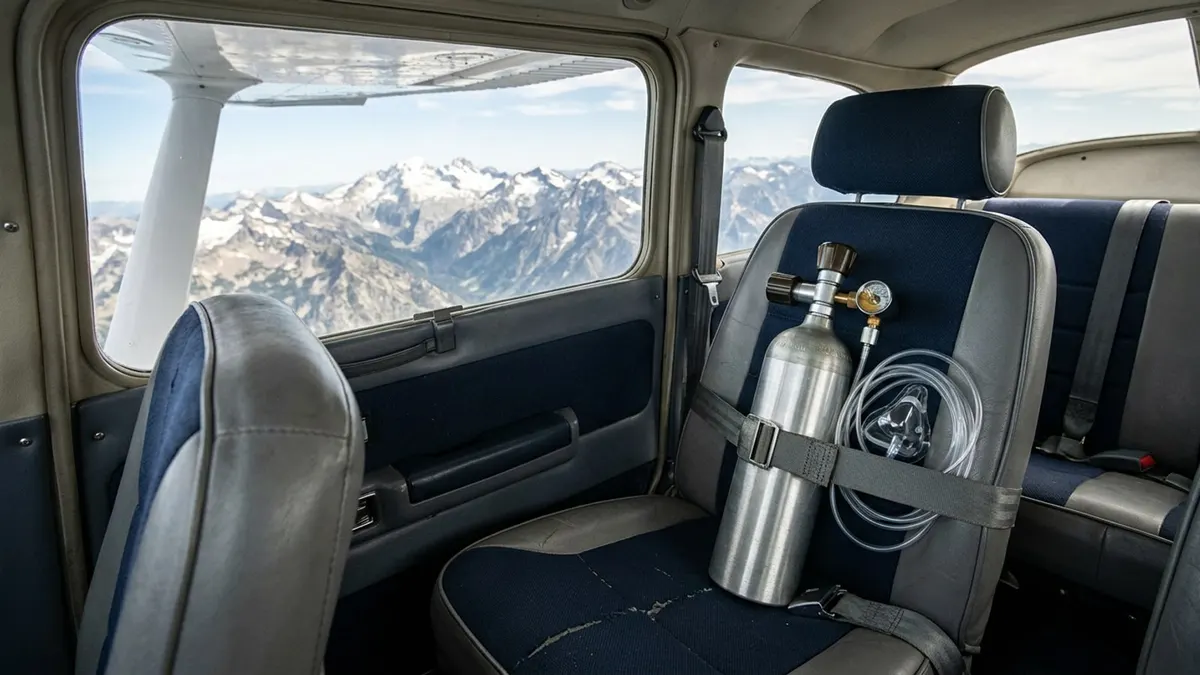
The FAA's minimum rule (14 CFR 91.211) requires the flight crew to use oxygen after 30 minutes above 12,500 feet cabin altitude, the whole time above 14,000 feet, and requires oxygen for every occupant above 15,000 feet. The FAA's own Aeronautical Information Manual goes further: it encourages pilots to use supplemental oxygen above 10,000 feet during the day and above 5,000 feet at night. If you fly over mountains or simply cruise at 10,500 to 12,500 feet, a portable system and a pulse oximeter are worth carrying.
For most piston pilots, that means a pulse-demand system such as Mountain High's O2D2, which Mountain High says makes a cylinder last two to three times longer than constant flow, plus a fingertip pulse oximeter like the Nonin TruO2 to watch your saturation. Use our oxygen rules calculator to see what applies to a specific flight.
When the rules and the FAA's advice say to use oxygen
| Cabin altitude | 14 CFR 91.211 (Part 91) | AIM 8-1-2 recommendation |
|---|---|---|
| Above 5,000 ft at night | Nothing required | Use oxygen |
| Above 10,000 ft by day | Nothing required | Use oxygen |
| Above 12,500 to 14,000 ft | Required crew must use it after 30 minutes | Use oxygen |
| Above 14,000 ft | Required crew must use it the whole time | Use oxygen |
| Above 15,000 ft | Every occupant must be provided with oxygen | Use oxygen |
Charter pilots under Part 135 have a lower threshold: 14 CFR 135.89 requires each pilot to use oxygen after 30 minutes above 10,000 feet (through 12,000 feet) and continuously above 12,000 feet.
Why the AIM sets the bar lower
The AIM says night vision deteriorates at a cabin altitude as low as 5,000 feet, and that while other significant effects of hypoxia usually do not occur below 12,000 feet in a healthy pilot, from 12,000 to 15,000 feet judgment, memory, alertness, coordination and the ability to calculate are impaired. It adds that pilot performance can seriously deteriorate within 15 minutes at 15,000 feet, and that carbon monoxide from smoking or exhaust leaks makes the effects worse. Hypoxia's effects are hard to recognize when they come on gradually, which is where a pulse oximeter helps.
Learning your own symptoms
The AIM makes a point that changes how to think about hypoxia: its symptoms do not vary in an individual, so once you have felt yours you can recognize them again. The FAA offers that experience through aviation physiology training with an altitude chamber at its Civil Aeromedical Institute in Oklahoma City and at military facilities. The AIM names three protections: avoid the factors that reduce tolerance to altitude, enrich the air you breathe with oxygen from an appropriate system, and keep a comfortable cabin pressure altitude. Mountain High, for its part, says its two-person O2D2 needs no manual flow adjustments in flight, because a built-in barometer sets the dose. If you fly high often, the chamber training is worth a day.
Portable oxygen systems
Constant flow vs pulse demand
A constant-flow system delivers oxygen all the time, including while you breathe out. A pulse-demand system delivers a dose only at the start of each breath. Mountain High describes its EDS O2D2 as supplying oxygen only at the beginning of inhalation, with a built-in barometer that adjusts the dose for altitude automatically, and says it averages two to three times the duration of a constant-flow system from the same cylinder.
What a system includes
Mountain High sells the O2D2 as a two-person kit and as complete systems with a regulator and cylinder, listing them from $995 for the kit without a regulator to $1,389 to $4,095 for complete systems. Its complete systems include standard and flare-tip cannulas and face masks; cylinders ship empty and are offered in aluminum or composite. These systems are sold by the maker and aviation dealers, not Amazon.
Cannula or mask
Mountain High includes both. Cannulas are more comfortable for long flights at moderate altitude; masks are used higher up. Follow the system maker's altitude limits for each.
Refilling
Cylinders are filled at FBOs and oxygen shops. Ask for aviator's breathing oxygen and follow the cylinder's hydrostatic test schedule printed on it.
Pulse oximeters
A fingertip pulse oximeter reads your blood oxygen saturation (SpO2) and pulse in a few seconds. In the cockpit it turns the vague early signs of hypoxia into a number you can act on: check it at altitude, compare with your reading on the ground, and use oxygen (or descend) if it trends down.
- The Nonin TruO2 3250 is FDA cleared for over-the-counter use and made in the USA by the company that invented the fingertip pulse oximeter (per Nonin's Amazon listing).
- The Braun fingertip pulse oximeter is a low-cost option that Braun describes as clinically validated for ages 12 and up.
Cold fingers, poor circulation and nail polish can affect readings. Treat the oximeter as a trend tool and a prompt, not a medical diagnosis, and remember that a pulse oximeter cannot tell oxygen from carbon monoxide on hemoglobin: if you suspect CO, see our CO detector guide.
A simple oxygen plan
- Check the flight in the oxygen rules calculator.
- Carry enough oxygen for the planned time at altitude, plus a reserve; check the cylinder pressure on preflight.
- Put the cannula on before you climb through 10,000 feet by day or 5,000 at night, as the AIM encourages.
- Check SpO2 periodically, and descend if the oxygen runs out or you feel unwell.
Frequently asked questions
At what altitude do pilots need oxygen?
Under 14 CFR 91.211, the required crew must use oxygen after 30 minutes above 12,500 feet cabin altitude and the whole time above 14,000 feet; every occupant must be provided with oxygen above 15,000 feet. The AIM encourages oxygen above 10,000 feet by day and 5,000 feet at night.
What is a pulse-demand oxygen system?
A system that delivers oxygen only at the start of each breath instead of continuously. Mountain High says its O2D2 averages two to three times the duration of constant flow from the same cylinder.
Do I need a pulse oximeter if I have oxygen?
It helps. Hypoxia comes on gradually and is hard to recognize, and an oximeter shows your saturation as a number. Use it as a trend tool, not a diagnosis.
Can a pulse oximeter detect carbon monoxide?
No. A standard pulse oximeter cannot distinguish carbon monoxide from oxygen on hemoglobin. Carry a CO detector as well.
Where do I refill an aviation oxygen cylinder?
At FBOs and oxygen suppliers. Ask for aviator's breathing oxygen and keep the cylinder within its hydrostatic test date.
What are the Part 135 oxygen rules for pilots?
14 CFR 135.89 requires each pilot to use oxygen after 30 minutes above 10,000 feet through 12,000 feet, and continuously above 12,000 feet.
Sources
- 14 CFR 91.211, Supplemental oxygen, Legal Information Institute
- 14 CFR 135.89, Pilot requirements: Use of oxygen, Legal Information Institute
- Aeronautical Information Manual, 8-1-2 Effects of Altitude, Federal Aviation Administration
- O2D2 Kits and Systems, Mountain High
Cover image: Illustration: Aviation Gear Review (AI-generated)
Related guides
Best Carbon Monoxide Detectors for Aircraft (2026): Portable and Built-In
Why the NTSB wants a CO detector in every piston airplane, what kind of alarm it recommends, and five ways to carry one.
Best Personal Locator Beacons for Pilots (2026): ACR and Ocean Signal
A PLB in your pocket goes with you if you leave the airplane. Four 406 MHz beacons compared, and what the ELT rule does and does not cover.
Best Red Flashlights and Headlamps for Pilots (2026)
Red light protects night vision but distorts chart colors, so the FAA says keep white light available too. Five lights that do both.