
Best Red Flashlights and Headlamps for Pilots (2026)
The best red flashlight for night flying: Sporty's red-and-white Smart Flashlight, ASA's FlightLight, a Nitecore headlamp, and what the AIM says about red light.
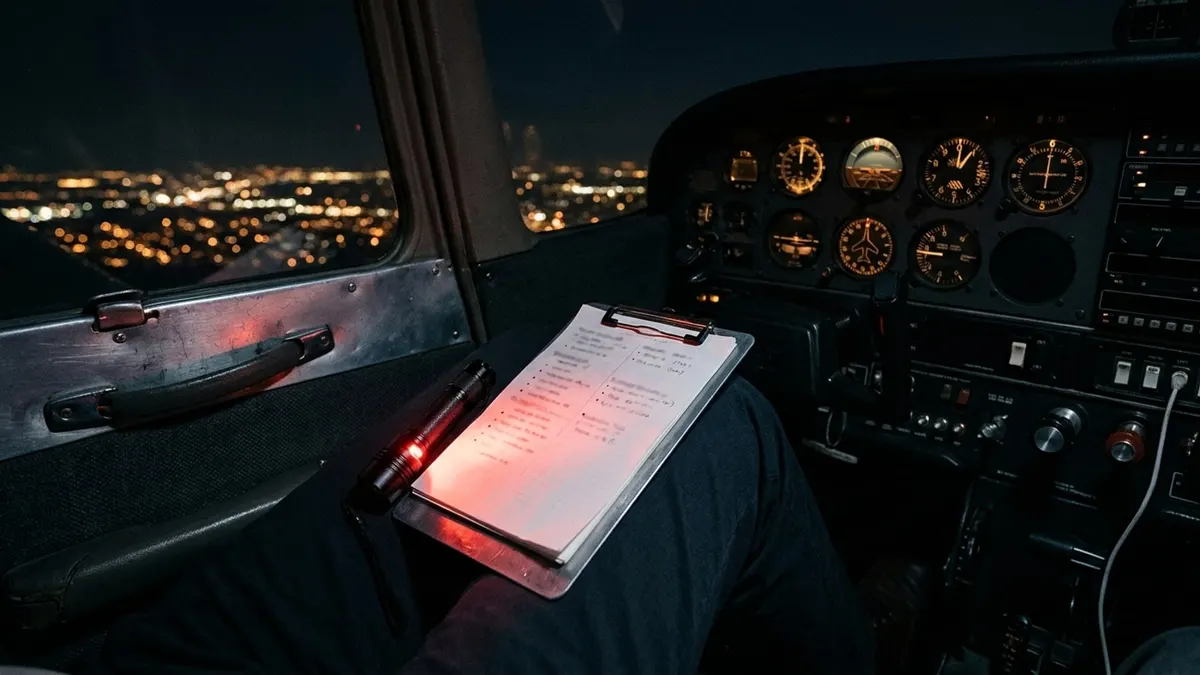
Affiliate disclosure: product links on this page go to Amazon or to the maker's own store. As an Amazon Associate we earn from qualifying purchases, at no extra cost to you; links to makers' own stores earn us nothing. No retailer or brand sees our picks before they are published or has any say in them. How we choose.
For night flying, buy a light that does both red and white. The FAA's Aeronautical Information Manual explains why: dim red cockpit light lets your eyes reach a moderate degree of dark adaptation in about 20 minutes, but red light severely distorts colors, especially on aeronautical charts, so white light must be available for map and instrument reading. Sporty's Rechargeable Smart Flashlight fits that brief: red and white light from a side switch, a display showing brightness and battery, a magnetic base, USB-C charging and an anti-roll body, at 4 ounces (per Sporty's Amazon listing).
For hands-free light, a headlamp with white and red beams like the Nitecore NU30 or a headset-mounted red light keeps your hands on the controls.
Our top picks at a glance
1. Best overall
Sporty's Flight Gear Rechargeable Smart FlashlightColors: Red and white · Power: Rechargeable, USB-C (1.5 to 2 h charge) · Mount: Clip and magnetic base · Weight: 4 oz
2. Best for chart colors
ASA FlightLight (red, green, white)Colors: Red, green and white · Power: See ASA · Mount: Handheld · Weight: See ASA
3. Best headlamp
Nitecore NU30 headlamp (white and red)Colors: White (1 to 500 lumens) and red · Power: Rechargeable, USB-C · Mount: Headband · Weight: 3.17 oz
4. Best headset-mounted
FlightPro headset-mount red light (FP20)Colors: Red, steady or SOS strobe · Power: One AA · Mount: Headset clip · Weight: Under 3 oz (per the listing)
5. Headlamp alternative
Princeton Tec Remix headlamp (red LEDs)Colors: White spot and red (high and low) · Power: See Princeton Tec · Mount: Headband · Weight: See Princeton Tec
| Pick | Colors | Power | Mount | Weight | Buy |
|---|---|---|---|---|---|
| Sporty's Flight Gear Rechargeable Smart FlashlightBest overall | Red and white | Rechargeable, USB-C (1.5 to 2 h charge) | Clip and magnetic base | 4 oz | Amazon |
| ASA FlightLight (red, green, white)Best for chart colors | Red, green and white | See ASA | Handheld | See ASA | Amazon |
| Nitecore NU30 headlamp (white and red)Best headlamp | White (1 to 500 lumens) and red | Rechargeable, USB-C | Headband | 3.17 oz | Amazon |
| FlightPro headset-mount red light (FP20)Best headset-mounted | Red, steady or SOS strobe | One AA | Headset clip | Under 3 oz (per the listing) | Amazon |
| Princeton Tec Remix headlamp (red LEDs)Headlamp alternative | White spot and red (high and low) | See Princeton Tec | Headband | See Princeton Tec | Amazon |
Best overall
Sporty's Flight Gear Rechargeable Smart Flashlight
A rechargeable red and white light built for the cockpit: magnetic, anti-roll and with a battery display.
- Colors
- Red and white
- Power
- Rechargeable, USB-C (1.5 to 2 h charge)
- Mount
- Clip and magnetic base
- Weight
- 4 oz
Pros
- Side switch between white for preflight and red for the cockpit
- Display shows color, mode, lumens and battery remaining
- Rectangular anti-roll body and remembers its last brightness
Cons
- Rechargeable only: keep it charged
- One-year warranty (per the listing)
Sporty's listing describes a white light for preflight inspections and a soft red light to preserve night vision, switched from the side; a digital display showing color, mode, brightness in lumens and remaining battery; a dual clip and a magnetic base; memory of the last brightness; USB-C charging in 1.5 to 2 hours; and a rectangular body about 4.5 by 1 by 0.5 inches, 4 ounces, that will not roll across the floor.
That combination answers the AIM's point: red for keeping your night vision, white for reading a chart's colors correctly.
Best for chart colors
ASA FlightLight (red, green, white)
ASA's three-color pilot flashlight, adding green light to red and white.
- Colors
- Red, green and white
- Power
- See ASA
- Mount
- Handheld
- Weight
- See ASA
Pros
- Red, green and white in one light
- Small enough for a shirt pocket
Cons
- The listing gives no battery or output details
- Not rechargeable (check ASA)
ASA's FlightLight (ASA-FL-3C) offers red, green and white LEDs in a pocket-size light. Green is a third choice between red, which the AIM warns distorts chart colors, and full white. The listing gives no specifications beyond the colors, so check ASA's page for battery type.
Best headlamp
Nitecore NU30 headlamp (white and red)
A light, rechargeable headlamp with white and red beams, for night preflights and hands-free cockpit light.
- Colors
- White (1 to 500 lumens) and red
- Power
- Rechargeable, USB-C
- Mount
- Headband
- Weight
- 3.17 oz
Pros
- Up to 97 hours on its lowest mode (per the listing)
- IP66 and impact resistant to 1 meter
- Red auxiliary LED for night vision
Cons
- A headband under a headset can be uncomfortable; wear it on the neck or a hat
- Easy to blind a passenger by turning your head
Nitecore lists the NU30 at 500 lumens maximum, with an auxiliary red light, a built-in 1,500 mAh lithium-ion battery that charges over USB-C in about 2 hours, up to 97 hours at its 6-lumen ultralow level, IP66, and 90 grams (3.17 ounces) with the headband. The Amazon listing adds a two-year warranty. For a night preflight it frees both hands for the fuel tester and the oil dipstick.
Best headset-mounted
FlightPro headset-mount red light (FP20)
A small red light that clips to the headset band and points where you look.
- Colors
- Red, steady or SOS strobe
- Power
- One AA
- Mount
- Headset clip
- Weight
- Under 3 oz (per the listing)
Pros
- Light follows your eyes to the instrument or chart
- Zoomable from flood to spot
- Single AA battery, no charging
Cons
- Red only; carry a white light for charts
- Fit depends on your headset model
FlightPro's FP20 clips to the headband of headsets including the Bose A20 and A30, Lightspeed Zulu and Sierra, David Clark H10-13.4 and Rugged Air RA200, per the listing. It has steady red and an SOS strobe, a zoomable lens, an aluminum body and runs on one AA cell. Pair it with a white light for reading charts.
Headlamp alternative
Princeton Tec Remix headlamp (red LEDs)
A headlamp with a dedicated cluster of red LEDs and a simple one-button mode cycle.
- Colors
- White spot and red (high and low)
- Power
- See Princeton Tec
- Mount
- Headband
- Weight
- See Princeton Tec
Pros
- Three red LEDs for short-range light
- Red high and red low modes
- IPX4 splash resistance
Cons
- One button cycles through white modes to reach red
- Listing gives no weight or battery figures
Princeton Tec's Remix pairs a white spot beam (high, medium and low) with a group of three red LEDs (red high and red low) and IPX4 water resistance, per the listing. Check that you can reach the red modes without flashing white in the cockpit.
What the FAA says about red light
AIM 8-1-6 explains that full dark adaptation takes at least 30 minutes in total darkness, but a pilot can reach a moderate degree of dark adaptation within 20 minutes under dim red cockpit lighting. It then cautions that red light severely distorts colors, especially on aeronautical charts, and can make it hard to focus on objects inside the aircraft, so red should be used only where the best outside night vision is needed, and white cockpit lighting must be available for map and instrument reading, especially under IFR. Any dark adaptation is lost within seconds of looking at a bright light, and the AIM adds that cabin altitudes above 5,000 feet and carbon monoxide also impair it.
So: a light with both red and white, dimmable, used sparingly.
What the Airplane Flying Handbook recommends
The FAA's Airplane Flying Handbook, in its chapter on night operations, recommends at least one reliable flashlight as standard equipment on every night flight, and says a dimmable light that can produce both white and red is preferable. It should be large enough to find easily when you need it, with a spare set of batteries within reach. The handbook assigns the colors: white for the preflight inspection, red for flight deck operations, and dim white for reading charts. It notes that some pilots carry two lights, a white one for the preflight and a red penlight hung on a string around the neck so it is always to hand.
The same chapter covers the iPad: charts on an EFB need no flashlight, but its brightness should be set so that it does not seriously impair night vision. The handbook also lists what else belongs within reach at night: aeronautical charts, the data for the flight and a flight deck checklist, all in a place you can reach without unstrapping.
Protecting your night vision
The AIM adds two habits and a list. Close one eye when you have to use a bright light, so that eye keeps some of its dark adaptation. Wear sunglasses in bright sun on the day of a night flight, because prolonged exposure to bright sunlight impairs dark adaptation; the AIM says sunglasses should absorb at least 85 percent of visible light. And know the other things on its list that work against you: cabin altitudes above 5,000 feet, carbon monoxide from smoking or exhaust fumes, and a diet short of vitamin A.
What to look for
Red and white in one light
Red for scanning the panel and finding switches; white, turned down, for chart colors and the preflight.
Dimming
Even red light ruins night vision if it is too bright. Choose a light with a low setting.
Hands-free options
A headlamp or headset light keeps both hands free for the controls and the radio. A magnetic base (Sporty's) lets a flashlight stick to a steel surface in the hangar during the preflight.
Power you can trust
Rechargeable lights need charging before night flights; AA lights can take fresh cells anywhere. Carry a backup either way: night flights end with a dark ramp.
How the picks compare
| Light | Red | White | Power | Hands-free |
|---|---|---|---|---|
| Sporty's Smart Flashlight | Yes | Yes | USB-C | Magnetic base |
| ASA FlightLight | Yes | Yes (plus green) | See ASA | No |
| Nitecore NU30 | Yes | Yes | USB-C | Headband |
| FlightPro FP20 | Yes | No | One AA | Headset clip |
| Princeton Tec Remix | Yes | Yes | See maker | Headband |
Keep the light in an outside pocket of your flight bag, next to the fuel tester. Flying at night in winter? Add a CO detector; the AIM notes carbon monoxide also impairs night vision.
Frequently asked questions
Why do pilots use red flashlights?
Dim red light lets your eyes keep much of their dark adaptation. The AIM says a pilot can reach a moderate degree of dark adaptation within 20 minutes under dim red cockpit lighting.
Is red light bad for reading charts?
Yes. The AIM warns that red light severely distorts colors, especially on aeronautical charts, and says white cockpit lighting must be available for map and instrument reading.
Should a pilot flashlight have red and white light?
Yes. Red for keeping night vision, white (turned down) for reading chart colors and for the preflight. Sporty's Smart Flashlight and ASA's FlightLight do both.
Is a headlamp good for flying?
A headlamp keeps your hands free, which helps on night preflights and in the cockpit. Use the red mode inside and avoid turning your head toward passengers with white light on.
How long does dark adaptation take?
The AIM says complete dark adaptation needs at least 30 minutes in total darkness, and any degree of it is lost within a few seconds of looking at a bright light.
Sources
- Aeronautical Information Manual, Chapter 8 Section 1 (8-1-2 and 8-1-6), Federal Aviation Administration
- NU30 headlamp, Nitecore
- Airplane Flying Handbook, Chapter 11: Night Operations, Federal Aviation Administration
Cover image: Illustration: Aviation Gear Review (AI-generated)
Related guides
Best Carbon Monoxide Detectors for Aircraft (2026): Portable and Built-In
Why the NTSB wants a CO detector in every piston airplane, what kind of alarm it recommends, and five ways to carry one.
Best Personal Locator Beacons for Pilots (2026): ACR and Ocean Signal
A PLB in your pocket goes with you if you leave the airplane. Four 406 MHz beacons compared, and what the ELT rule does and does not cover.
Portable Aviation Oxygen: When You Need It, Pulse-Demand Systems and Oximeters
The FAA's rule and its stricter recommendation, how a pulse-demand system stretches a cylinder, and where a fingertip pulse oximeter fits in.