
Sentry Plus vs Sentry Mini (and the Standard Sentry): Which to Buy
ForeFlight Sentry Plus vs Sentry Mini vs Sentry, from ForeFlight's own comparison: price, battery, AHRS, CO alarm, track logging, FLARM and who needs which.
Affiliate disclosure: product links on this page go to Amazon or to the maker's own store. As an Amazon Associate we earn from qualifying purchases, at no extra cost to you; links to makers' own stores earn us nothing. No retailer or brand sees our picks before they are published or has any say in them. How we choose.
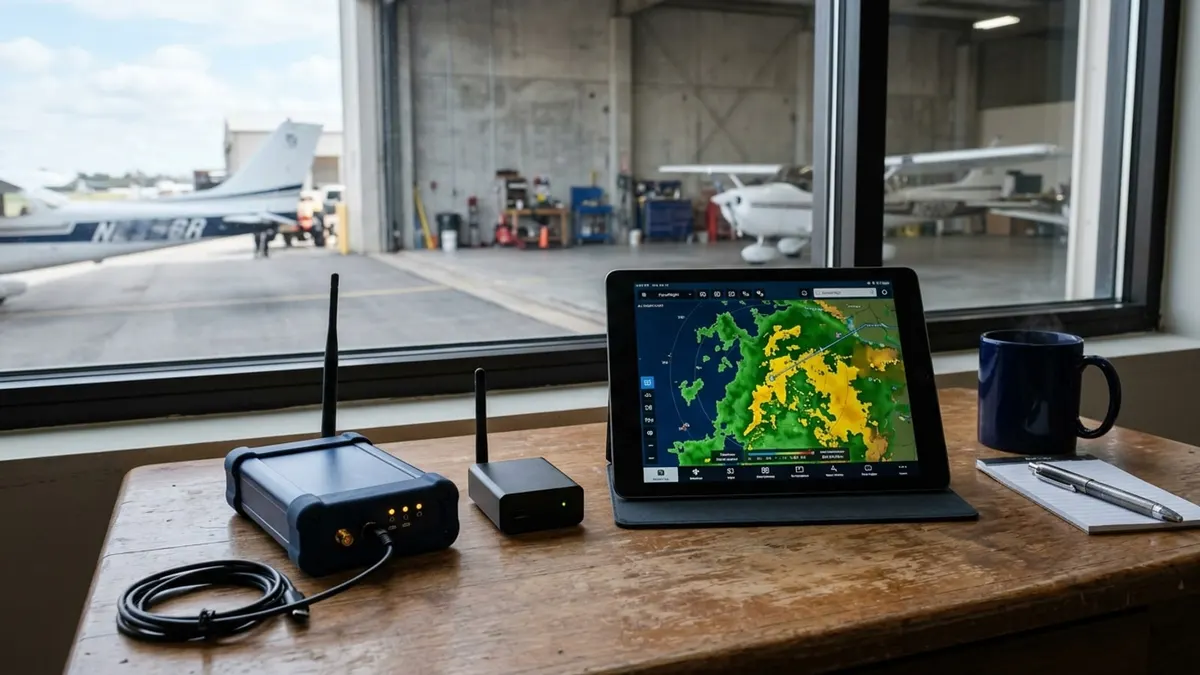
Buy the Sentry Mini ($449) if you fly VFR with ForeFlight, your airplane has a USB-C power source, and you want traffic, FIS-B weather and GPS without the extras. Buy the Sentry Plus ($799) if you want the full set: an 18-hour battery, backup attitude, pressure altitude, a carbon monoxide alarm, track logging and FLARM. The standard Sentry ($649) sits between them: the same safety features as the Plus with a 12-hour battery and no logging.
All three get identical ADS-B traffic and weather. This comparison uses ForeFlight's own model table; prices are ForeFlight's, and all three are sold by ForeFlight and its dealers rather than Amazon.
The three Sentry models side by side
| Feature | Sentry Mini | Sentry | Sentry Plus |
|---|---|---|---|
| Price (ForeFlight) | $449 | $649 | $799 |
| Dual-band ADS-B traffic | Yes | Yes | Yes |
| FIS-B weather | Yes | Yes | Yes |
| WAAS GPS, multi-constellation | Yes | Yes | Yes |
| Weather replay storage | Yes | Yes | Yes |
| Internal battery | None | 12 hours | 18 hours |
| Backup attitude (AHRS) | No | Yes | Yes |
| Barometer (pressure altitude) | No | Yes | Yes |
| CO monitor and alarm | No | Yes | Yes |
| Auto shutdown after inactivity | No | Yes | Yes |
| g-meter | No | No | Yes |
| On-device track logging | No | No | Yes |
| Auto on/off with external power | No | No | Yes |
| FLARM traffic | No | No | Yes (license from ForeFlight) |
| WiFi devices | Up to 5 | Up to 5 | Up to 5 |
| USB | USB-C | USB-C | USB-C with Power Delivery |
| In the box | RAM suction mount, power cable, pouch | RAM suction mount, charging cable, case | RAM suction mount, charging cable, case |
What is the same
Traffic and weather do not change between models. Each Sentry receives dual-band ADS-B traffic and the FAA's free FIS-B weather, has a WAAS GPS with multi-constellation support to give a WiFi-only iPad a position, stores up to 30 minutes of FIS-B data for weather replay, and gets firmware updates through the ForeFlight app. All three work with ForeFlight Mobile and OzRunways, and serve up to five devices over WiFi.
The differences that matter
Battery
The Sentry Mini has no internal battery at all. It runs from USB-C power for the whole flight, so you need a reliable USB source in the cockpit and a cable route to a window position. The standard Sentry runs 12 hours on its internal battery and the Plus 18, enough to charge at home and fly all day unplugged.
Backup attitude and pressure altitude
The Sentry and Sentry Plus add an AHRS, which drives ForeFlight's synthetic vision and attitude display, and a barometer for pressure altitude. Neither makes the iPad a certified instrument, but a backup attitude display is useful if a vacuum pump fails in instrument conditions.
The CO alarm
The Sentry and Sentry Plus include a carbon monoxide monitor and alarm. Carbon monoxide from an exhaust leak is odorless, and most piston airplanes heat the cabin with air warmed around the exhaust. If you fly a piston airplane in winter and do not already have a dedicated detector, this feature alone justifies stepping up from the Mini. Our aviation CO detector guide covers standalone options.
Plus-only features
The Sentry Plus adds a g-meter, on-device track logging, automatic power on and off with external power, USB-C Power Delivery, and FLARM traffic, which ForeFlight describes as optimized for FLARM reception in Europe and which needs a license bought through ForeFlight. Track logging means you have a record of the flight even if the iPad was not recording.
What each step up costs
| Step | Extra cost | What it buys |
|---|---|---|
| Sentry Mini to Sentry | $200 | A 12-hour battery, backup attitude, a barometer, the CO monitor and alarm, auto shutdown |
| Sentry to Sentry Plus | $150 | 6 more hours of battery, a g-meter, track logging, automatic on and off, USB-C Power Delivery, FLARM |
| Sentry Mini to Sentry Plus | $350 | All of the above, for 78 percent more than the Mini |
The first step is the one that changes what the receiver does in an emergency: a battery if the airplane's electrical system fails, an attitude reference, and a carbon monoxide alarm. The second step is convenience and record-keeping.
Using a Sentry with OzRunways
ForeFlight says pilots who fly with the OzRunways app can connect to a Sentry for ADS-B traffic, pitch and roll from the AHRS, GPS position and the CO monitor and alarm. FIS-B weather is not on that list; it is an FAA broadcast, so it matters only in US airspace.
Sharing one Sentry
Each Sentry creates its own Wi-Fi network for up to five devices, and ForeFlight's Cockpit Sharing passes routes between the devices on it, so a second pilot's iPad and a passenger's phone can follow the same flight plan. Each ships with a RAM suction cup mount. Mount it where it has a clear view of the sky, and with the Mini plan the power cable so that it does not cross the yoke.
What none of them does
No Sentry transmits, so none of them meets the ADS-B Out rule. The FAA describes its rebroadcast traffic services, TIS-B and ADS-R, as provided to aircraft equipped with ADS-B Out and In, so in an airplane without ADS-B Out the traffic picture can be incomplete. And the attitude display is a backup for situational awareness; it does not make the iPad a certified instrument. If you are buying for someone else, check which app they fly with first.
Who should buy which
- Sentry Mini: VFR flying, a dependable USB-C source, and a separate CO detector already on board.
- Sentry: you want backup attitude and a CO alarm and are happy with a 12-hour battery.
- Sentry Plus: long days, instrument flying, or flying in Europe where FLARM is used, and you want logging.
- None of them: if you do not use ForeFlight or OzRunways, look at the Garmin GDL 52 or a Stratux in our best portable ADS-B receivers guide.
Whichever you buy, it is ADS-B In only and does not satisfy the ADS-B Out rule; see ADS-B In vs ADS-B Out. To keep it and your iPad in view, see the best iPad yoke mounts.
Frequently asked questions
What is the difference between the Sentry Plus and Sentry Mini?
Same traffic, weather and GPS. The Plus ($799) adds an 18-hour battery, backup attitude, a barometer, a CO alarm, a g-meter, track logging and FLARM. The Mini ($449) has no battery and none of those extras.
Does the Sentry Mini have a battery?
No. ForeFlight's comparison lists no internal battery for the Sentry Mini, so it needs USB-C power for the whole flight.
Does the Sentry have a carbon monoxide detector?
The standard Sentry and the Sentry Plus have a CO monitor and alarm. The Sentry Mini does not.
Do Sentry receivers work with Garmin Pilot?
ForeFlight lists ForeFlight Mobile and OzRunways as compatible apps. For Garmin Pilot, look at Garmin's GDL receivers or a Stratux.
Is the Sentry Plus worth the extra $150 over the Sentry?
If you fly long days, or fly in Europe where FLARM is used, yes: you get 6 more hours of battery, track logging, a g-meter, automatic power on and off and FLARM. For most pilots the standard Sentry's 12 hours is enough.
How many iPads can connect to a Sentry?
Up to five devices over WiFi, on all three models, per ForeFlight.
Sources
- Sentry: The Next Generation of ADS-B Receivers (model comparison), ForeFlight
- Ins and Outs (ADS-B In services), Federal Aviation Administration
- 14 CFR 91.225, ADS-B Out equipment and use, Legal Information Institute
Cover image: Illustration: Aviation Gear Review (AI-generated)
Related guides
ADS-B In vs ADS-B Out: What the Rule Requires and What a Portable Receiver Does
ADS-B Out is the transmitter the 2020 rule requires; ADS-B In is the receiver that shows you traffic and weather. Here is the rule, the airspace and the two frequencies.
Best Handheld Aviation Radios of 2026: Icom, Yaesu and Sporty's Compared
Five handheld transceivers compared on transmit power, battery life, NAV features and how they connect to your headset, from a six-AA backup to a GPS NAV/COM.
Best iPad for Pilots in 2026: Which iPad to Buy for ForeFlight and Garmin Pilot
Buy the cellular model for the built-in GPS, pick the size your cockpit can hold, and mind Apple's 95 °F operating limit. Here is which iPad fits which pilot.