
Best Aircraft Fuel Testers of 2026: GATS Jar, Compact and Classic Samplers
The best aircraft fuel tester for preflight sumping: GATS Jar 12 and 16 oz, MCP Aviation's compact tester and the classic sampler, with the FAA's sumping steps.
Affiliate disclosure: product links on this page go to Amazon or to the maker's own store. As an Amazon Associate we earn from qualifying purchases, at no extra cost to you; links to makers' own stores earn us nothing. No retailer or brand sees our picks before they are published or has any say in them. How we choose.
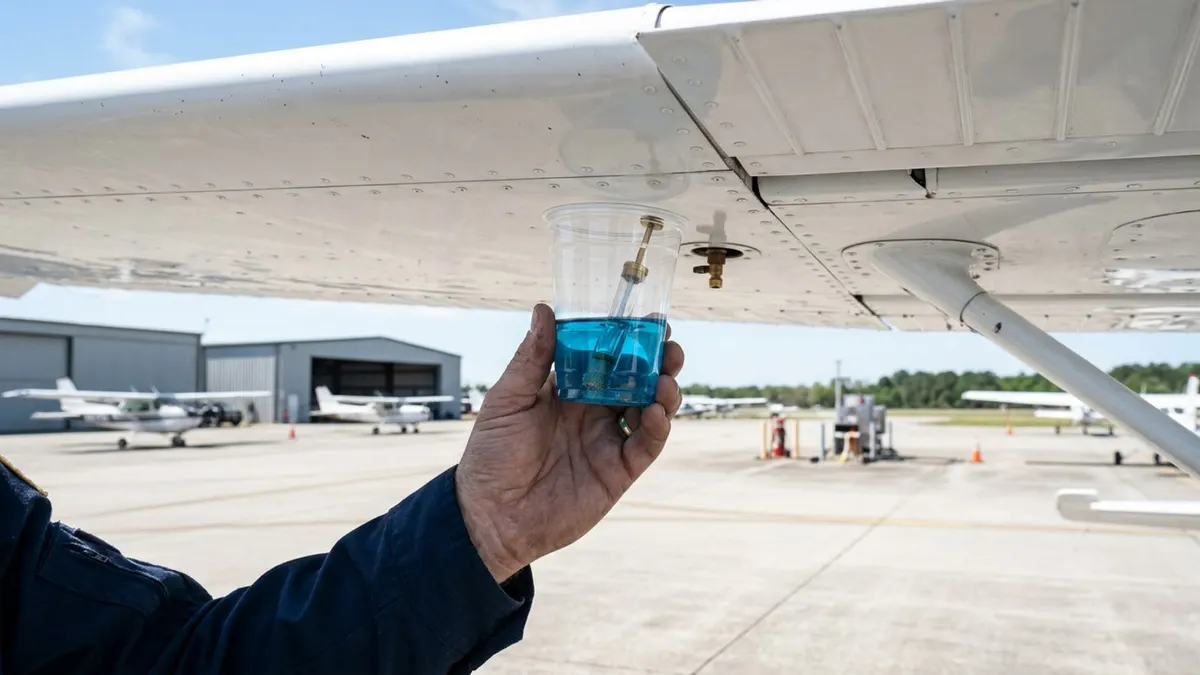
The GATS Jar is the fuel tester we would buy: a 12-ounce jar with an integral filter that separates water and particles, so clean fuel can go back in the tank instead of on the ramp, and a pin for pin-type drains (per the listing). For a smaller flight bag, MCP Aviation's compact 4-ounce tester has an integrated funnel and pouring spout and is made in the US.
Whichever you use, the FAA's Airplane Flying Handbook says to drain enough fuel from the strainer and each tank sump to check grade and color, water, dirt and odor, during preflight and after refueling, in the order your POH specifies.
Our top picks at a glance
1. Best overall
GATS Jar fuel tester (12 oz)Capacity: 12 oz · Returns fuel: Yes, integral filter · Drain types: Pin-type drains · Made in: See maker
2. Best compact
MCP Aviation compact fuel tester (4 oz)Capacity: 4 oz · Returns fuel: Pour spout · Drain types: 3 mm stainless actuator rod · Made in: USA (per the listing)
3. Best budget
Classic yellow fuel tester (391S)Capacity: Single tube · Returns fuel: No · Drain types: Pin and push drains · Made in: See maker
4. Best for many sumps
GATS Jar fuel tester (16 oz)Capacity: 16 oz · Returns fuel: Yes, integral filter · Drain types: Pin-type drains · Made in: See maker
| Pick | Capacity | Returns fuel | Drain types | Made in | Buy |
|---|---|---|---|---|---|
| GATS Jar fuel tester (12 oz)Best overall | 12 oz | Yes, integral filter | Pin-type drains | See maker | Amazon |
| MCP Aviation compact fuel tester (4 oz)Best compact | 4 oz | Pour spout | 3 mm stainless actuator rod | USA (per the listing) | Amazon |
| Classic yellow fuel tester (391S)Best budget | Single tube | No | Pin and push drains | See maker | Amazon |
| GATS Jar fuel tester (16 oz)Best for many sumps | 16 oz | Yes, integral filter | Pin-type drains | See maker | Amazon |
Best overall
GATS Jar fuel tester (12 oz)
A filtered jar that lets you return clean fuel to the tank and sample more than once.
- Capacity
- 12 oz
- Returns fuel
- Yes, integral filter
- Drain types
- Pin-type drains
- Made in
- See maker
Pros
- Integral filter separates water and particulates
- Clean fuel goes back in the tank, not on the ground
- Room for several samples
Cons
- Bulkier than a tube tester
The GATS Jar's listing describes a 12-ounce capacity, an integral filter that separates water and particulates from fuel, a sturdy pin for pin-type drains, and the point of the design: reusing clean fuel instead of dumping avgas. Because you are not throwing fuel away, you are more likely to keep sampling until it is clear, which is what the Airplane Flying Handbook asks for. A 16-ounce version suits airplanes with many sumps.
Best compact
MCP Aviation compact fuel tester (4 oz)
A small, US-made tester with a funnel and spout that fits an outside pocket of a flight bag.
- Capacity
- 4 oz
- Returns fuel
- Pour spout
- Drain types
- 3 mm stainless actuator rod
- Made in
- USA (per the listing)
Pros
- Integrated funnel limits splashing
- Stainless steel actuator rod fits most GA sumps (per the listing)
- Manufactured and assembled in the US
Cons
- 4 oz fills quickly on airplanes with many sumps
- No filter
MCP Aviation's second-generation tester is 3D printed in fuel-resistant plastic, with an integrated funnel that guides the sample into a 4-ounce catch jar, a 3 mm stainless steel actuator rod and an improved pouring spout, made and assembled in the United States, per the listing.
Best budget
Classic yellow fuel tester (391S)
The classic yellow tube tester, cheap enough to keep one in every airplane you fly.
- Capacity
- Single tube
- Returns fuel
- No
- Drain types
- Pin and push drains
- Made in
- See maker
Pros
- Cheapest tester here
- Small and familiar
Cons
- No filter; samples are usually dumped
- Easy to lose
The yellow 391S-style tester is the tube many trainers have tied to a string in the seat pocket. It works; the downside is that each sample usually ends up on the ground.
Best for many sumps
GATS Jar fuel tester (16 oz)
The larger GATS Jar, for twins and airplanes with several sump points.
- Capacity
- 16 oz
- Returns fuel
- Yes, integral filter
- Drain types
- Pin-type drains
- Made in
- See maker
Pros
- More capacity for long sump sequences
- Same filter design as the 12 oz
Cons
- Bigger to carry
The 16-ounce GATS Jar uses the same filter-and-return idea with more room, which helps when the POH calls for sampling several tank sumps plus the gascolator.
What to look for in a fuel sample
The FAA's Airplane Flying Handbook (Chapter 2) says to drain enough fuel from the strainer quick drain and from each tank sump to check fuel grade and color, water, dirt and odor:
- Color: 80/87 avgas is dyed red, 100LL blue and 100/130 green. 100LL's blue can be hard to see unless you hold the sample against a white background in good light.
- Water: it settles to the bottom of the sample jar in bubble- or bead-like droplets, often clear, sometimes muddy yellow to brown with specks of dirt. Keep sampling until no water or contamination appears.
- Dirt and specks: small dark specks can be rubber from deteriorating fuel tanks, seals or sealant.
The handbook says significant or consistent water, sediment or contamination is grounds for further investigation by maintenance, and that each tank sump should be drained during preflight and after refueling, in the order the AFM or POH gives. It also explains why water appears: condensation in partly filled tanks, since water is heavier than fuel and collects at the low points. Filling the tanks after each flight minimizes it.
Wrong fuel: what the sample tells you
The Airplane Flying Handbook says every grade of avgas has a familiar gasoline scent and texture. Jet fuel does not: it is kerosene-based, has a stubborn, distinctive odor, feels oily to the touch, and is clear or straw-colored, though it can look dyed once it is mixed with avgas. The handbook's warning is that a piston engine misfueled with jet fuel may start, run and carry the airplane into the air before it fails. Smell the sample and rub a drop between your fingers as well as looking at it.
Two more checks from the same chapter. Jet fuel nozzles are flared at the end so they will not fit an avgas filler, and jet trucks carry JET-A placards in white on black, so watch the fueling when you can. And a lower grade of fuel must never be substituted for a required higher one, because detonation can damage an engine in minutes.
Water: where it comes from and when to keep draining
The handbook names three routes for water: condensation in partly filled tanks, deteriorated fuel cap seals left out in the rain, and the supplier's own tanks and trucks. Its prevention is to fill the tanks after each flight, or at least after the last flight of the day. It also gives a warning that changes how you read a sample: in extreme cases the entire sample may be water, with no line to see, particularly if the sample is small. That is the argument for a jar over a short tube, and for checking color and smell every time.
Lycoming adds why it matters more in winter: in freezing temperatures even a tiny bubble of moisture can freeze in a fuel line and cut off the flow.
While you are at the wing
- Confirm the quantity by looking in each tank, not only at the gauges, and put the caps back on securely.
- Treat any fuel stain on the wing as a probable leak, however old it looks; on wet-wing tanks, look along the rivet lines.
- Check the tank vent with a flashlight for damage or blockage. A blocked vent ends in fuel starvation, and the handbook says a rush of air when you crack the cap points to a serious vent problem.
The handbook's summary is that the pilot must verify three things about the fuel before every flight: the quantity, with adequate and legal reserves; the grade; and the quality. A tester covers the last two.
Choosing a tester
Filter and return
A filtered jar like the GATS lets clean fuel go back in the tank. That saves avgas and keeps it off the ramp.
Drain type
Most GA sumps are pin-type or push-type. Check that the tester's pin or rod fits your airplane's drains, especially on low-wing sumps under fairings.
Size and storage
A 4-ounce tester fits a flight bag's outside pocket; a 16-ounce jar suits a twin. Many flight bags have a dedicated fuel tester pocket.
How the picks compare
| Tester | Capacity | Filter | Best for |
|---|---|---|---|
| GATS Jar 12 oz | 12 oz | Yes | Most singles |
| MCP Aviation | 4 oz | No | Small flight bags |
| Yellow 391S tube | Tube | No | A spare in every airplane |
| GATS Jar 16 oz | 16 oz | Yes | Twins, many sumps |
Night preflight? Use a flashlight with white light to judge fuel color; the AIM warns red light distorts colors. Tying down afterwards? See tie-downs and chocks.
Frequently asked questions
How do I check aircraft fuel for water?
Drain a sample from the strainer and each tank sump into a clear tester. Water settles to the bottom as bead-like droplets. Keep sampling until no water or contamination appears, per the FAA's Airplane Flying Handbook.
What color is 100LL avgas?
Blue. 80/87 is red and 100/130 is green. Hold the sample against a white background in good light to see 100LL's color.
When should I sump the fuel?
During the preflight and after refueling, following the order in your airplane's AFM or POH, per the Airplane Flying Handbook.
Can I pour a fuel sample back into the tank?
Only if it is clean. Filtered testers like the GATS Jar separate water and particles so clean fuel can be returned; contaminated fuel should not go back in the tank.
What do dark specks in a fuel sample mean?
The Airplane Flying Handbook says small dark specks can come from deteriorating rubber fuel tanks, seals or sealant. Consistent contamination should be investigated by maintenance.
Sources
- Airplane Flying Handbook, Chapter 2: Ground Operations, Federal Aviation Administration
- Aeronautical Information Manual, 8-1-6 Vision in Flight, Federal Aviation Administration
- Operating in Cold Weather, Lycoming
Cover image: Illustration: Aviation Gear Review (AI-generated)
Related guides
Aircraft Engine Preheaters: When Lycoming Says to Preheat, and Tanis vs Reiff
Lycoming's own threshold, why the whole engine and oil system need heat, and the two installed preheat designs most owners choose between.

Aircraft Tie-Downs and Chocks: The FAA's Guidance and the Kits That Meet It
The FAA's tie-down circular asks for ropes that resist about 3,000 pounds of pull. Here is how popular kits compare, and how to tie down and chock.

Aircraft Tugs for Owners: Electric, Drill-Powered and Manual Compared
For airplanes up to 4,000 pounds, a tug comes down to three questions: your gross weight, your gear type and the surface you push on.