
Aircraft Tie-Downs and Chocks: The FAA's Guidance and the Kits That Meet It
Aircraft tie-down kits checked against FAA AC 20-35C's 3,000-pound rope guidance: The Claw, Aetheron, Sporty's Chockmate and the light Sporty's kit, plus chocks.
Affiliate disclosure: product links on this page go to Amazon or to the maker's own store. As an Amazon Associate we earn from qualifying purchases, at no extra cost to you; links to makers' own stores earn us nothing. No retailer or brand sees our picks before they are published or has any say in them. How we choose.
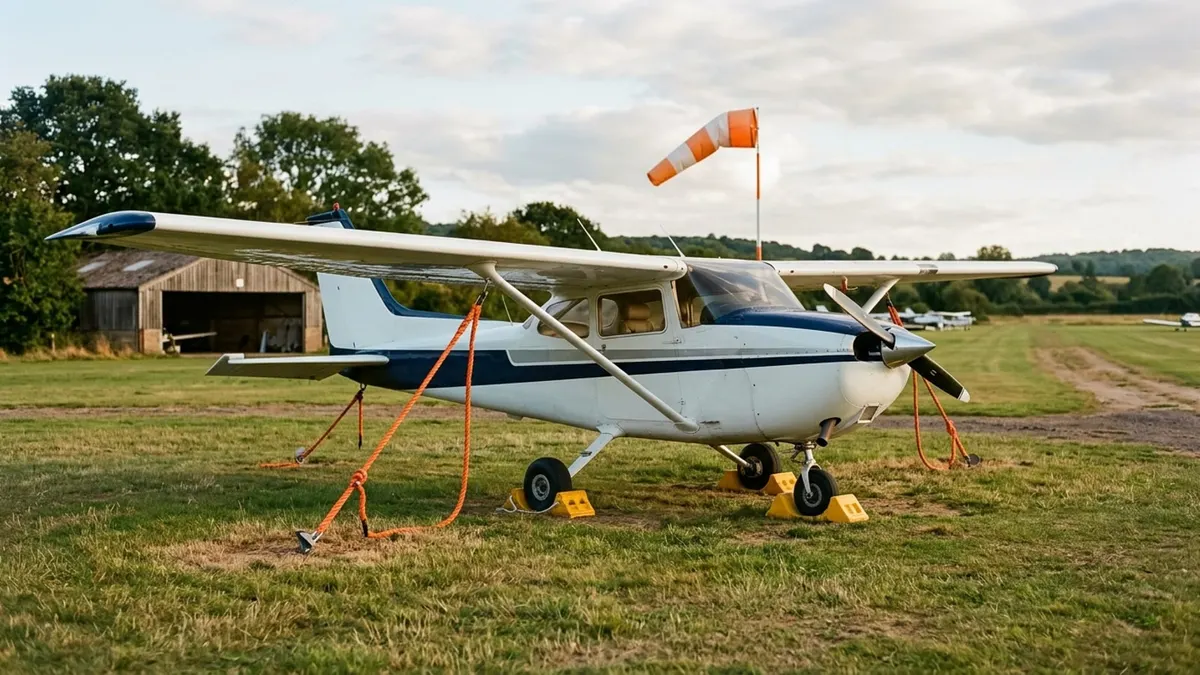
The FAA's tie-down advisory circular, AC 20-35C ("Tiedown Sense"), says tie-down ropes should resist a pull of approximately 3,000 pounds, that nylon or dacron rope is preferred over manila, and that aircraft should be parked headed into the wind as nearly as possible. Measured against that, ground-anchor kits such as The Claw C-100 (1,200 pounds per anchor, per the listing) and the Aetheron 24-piece kit (which says it supports 4,500 pounds or more per unit and is engineered to AC 20-35C) are the ones to carry for grass strips and fly-ins.
For ramps with fixed tie-down rings, the ropes matter more than anchors. Sporty's Chockmate kit rates each rope at 1,760 pounds; its lighter Tie-Down Kit rates each rope at 440 pounds of breaking force, which is quick and convenient but far below the FAA's guidance for windy nights.
What AC 20-35C says
- Ropes: tie-down ropes capable of resisting a pull of approximately 3,000 pounds should be used. Nylon or dacron are preferred over manila, which shrinks when wet, mildews, rots and has considerably less tensile strength. Inspect manila periodically if you must use it.
- Direction: park and tie down headed into the wind, or as nearly as the fixed mooring points allow, based on prevailing or forecast wind.
- Spacing: tie-downs should allow ample wingtip clearance.
- Your aircraft's instructions: learn the manufacturer's tie-down guidance, including ring locations, nosewheel versus tailwheel differences, and any charts for weights and wind speeds that call for extra measures.
The circular also warns that ground anchors can pull out when the ground is soaked by the heavy rain that comes with hurricanes and thunderstorms.
More from AC 20-35C: anchors, spacing and covers
- Anchors. Tie-down anchors for single-engine aircraft should hold approximately 3,000 pounds each, the same figure the circular gives for ropes, and a parking area should give each airplane three tie-down points.
- Stakes. The circular's own drawing says not to depend on wooden stakes, and its text warns that stake-driven tie-downs almost invariably pull out once the ground is soaked.
- Spacing. Tie-downs should be spaced at the wingspan or fuselage length of the largest airplane that normally parks there, whichever is greater, plus 10 feet.
- Wheels and openings. Lock the nosewheel or tailwheel fore and aft once parked, fasten doors and windows, and cover engine openings and pitot-static tubes.
- Before a storm. The circular ranks the choices: fly the airplane out of the storm's path if there is enough warning, then a hangar, then a secure tie-down.
It also says an airplane should be tied down at the end of every flight, not only when weather is forecast.
How tie-down kits compare with the FAA's 3,000-pound guidance
| Kit | Type | Maker's rating | Weight | Against AC 20-35C |
|---|---|---|---|---|
| Aetheron 24-piece (Gen 2) | Ground anchors, five stakes each | 4,500 lb or more per unit | Under 11 lb total | Meets it, per the maker |
| The Claw C-100 | Ground anchors, three stakes each | 1,200 lb per Claw | 8 lb | Below 3,000 per anchor |
| Sporty's Chockmate | Anchor chocks with nails, three 12 ft ropes | 1,760 lb per rope | 15 lb | Below 3,000 per rope |
| Sporty's Tie-Down Kit | Ratchet ropes for fixed rings | 440 lb breaking force per rope | Light | Far below |
Ratings come from each maker's listing and are not measured the same way (per anchor, per unit or per rope). A rating below 3,000 pounds does not mean a kit is useless; it means it is a convenience kit for calm overnights, and you should add stronger ropes or the ramp's own chains when wind is forecast.
The kits
Aetheron 24-piece (best for strength)
Aetheron's listing describes five stakes per anchoring point against competitors' three, 4,500 pounds or more of force per unit, an 18-inch anchoring bracket and a total weight under 11 pounds, and says it is engineered to AC 20-35C.
The Claw C-100 (best known)
The Claw's 14-piece kit has three anchors, nine hardened spikes, a hammer, 30 feet of rope and a bag, 8 pounds in all, with a lifetime warranty and a rating of 1,200 pounds per Claw (per the listing). It is quick to set and leaves no hole for tires to find.
Sporty's Chockmate (anchors that double as chocks)
Sporty's Chockmate has three anchor chocks, twelve nails, three 12-foot reflective orange ropes rated at 1,760 pounds each, a dual-purpose hammer and a canvas bag, 15 pounds in all. Each anchor doubles as a wheel chock, which saves carrying both.
Sporty's Tie-Down Kit (light ropes for ramps)
Two 10-foot ropes and one 6-foot rope with ratchet hooks and quick-release buttons, in a small bag, rated at 440 pounds breaking force each. Convenient for a lunch stop with fixed rings; for anything windier, use stronger rope.
Chocks
Chock the main wheels whenever the airplane is parked and the parking brake is not set, and always before you hand-prop or work on it. Rubber or wood chocks with a rope between them are easy to pull in one motion and hard to forget. Remember to remove them before you taxi; a Remove Before Flight streamer on the rope helps.
A tie-down routine
- Park headed into the forecast wind, with wingtip clearance from neighbors.
- Chock the mains.
- Tie each wing and the tail with rope that resists about 3,000 pounds of pull; leave a little slack so the airplane can move without snatching the rope.
- Install the control lock and gust locks, and put the fuel tester back in the bag for the morning.
- In storms, add anchors or move the airplane into a hangar; soaked ground can let anchors pull out.
Moving the airplane into the hangar? See our aircraft tug guide.
Frequently asked questions
How strong should aircraft tie-down ropes be?
FAA AC 20-35C says tie-down ropes capable of resisting a pull of approximately 3,000 pounds should be used, and that nylon or dacron is preferred over manila.
Which way should I park an airplane to tie it down?
Headed into the wind, or as nearly as the fixed tie-down points allow, based on prevailing or forecast wind, per AC 20-35C.
Is The Claw strong enough?
The Claw C-100 listing rates each anchor at 1,200 pounds, which is below the 3,000-pound rope guidance in AC 20-35C. Aetheron's kit claims 4,500 pounds or more per unit.
What is the best tie-down kit for grass strips?
A ground-anchor kit: the Aetheron 24-piece for strength, or The Claw C-100 for a lighter, well-known kit. Sporty's Chockmate combines anchors and chocks.
Can ground anchors pull out?
Yes. AC 20-35C warns anchors can pull out when the ground is soaked by the heavy rain that comes with hurricanes and some thunderstorms.
Do I need chocks if I tie down?
Chocking the main wheels stops the airplane rolling while you tie it down and when the parking brake is not set. Many kits, like Sporty's Chockmate, combine both.
Sources
- AC 20-35C, Tiedown Sense, Federal Aviation Administration
- Airplane Flying Handbook, Chapter 2: Ground Operations, Federal Aviation Administration
Cover image: Illustration: Aviation Gear Review (AI-generated)
Related guides
Aircraft Engine Preheaters: When Lycoming Says to Preheat, and Tanis vs Reiff
Lycoming's own threshold, why the whole engine and oil system need heat, and the two installed preheat designs most owners choose between.
Aircraft Tugs for Owners: Electric, Drill-Powered and Manual Compared
For airplanes up to 4,000 pounds, a tug comes down to three questions: your gross weight, your gear type and the surface you push on.
Best Aircraft Fuel Testers of 2026: GATS Jar, Compact and Classic Samplers
What the FAA's Airplane Flying Handbook says to look for in a fuel sample, and four testers that make it easier.