
Best Pilot Logbooks in 2026: Paper Logs for Students and Pros, and Going Digital
The best pilot logbook for your stage of flying: ASA's Standard Pilot Log, the larger Master Log, Jeppesen's Professional log, and what 14 CFR 61.51 requires.
Affiliate disclosure: product links on this page go to Amazon or to the maker's own store. As an Amazon Associate we earn from qualifying purchases, at no extra cost to you; links to makers' own stores earn us nothing. No retailer or brand sees our picks before they are published or has any say in them. How we choose.
Student and private pilots should start with ASA's Standard Pilot Log (SP-30): its columns line up with what 14 CFR 61.51 says you must record (date, aircraft make and model and ident, departure and arrival points, category, dual received and PIC time, day, night, cross-country, actual and simulated instrument, approaches and landings), it adds a ground instruction log, an annual summary and a list of aircraft flown, and Amazon sells it directly.
Pilots heading for a career, who will log thousands of hours, want a larger book such as ASA's Standard Pilot Master Log (SP-6) or the Jeppesen Professional Pilot Logbook. Many pilots also keep a digital log; the rule only asks that records be kept "in a manner acceptable to the Administrator."
Our top picks at a glance
1. Best for students
ASA Standard Pilot Log (SP-30)Best for: Student and private pilots · Format: Hardcover, pocket size · Instrument columns: Actual, simulated, approaches · Sold by: Amazon.com
2. Best for a career
ASA Standard Pilot Master Log (SP-6)Best for: Commercial and airline-track pilots · Format: Large hardcover · Instrument columns: Yes · Sold by: Amazon.com
3. Best Jeppesen alternative
Jeppesen Professional Pilot LogbookBest for: Professional pilots · Format: Hardcover, brown · Instrument columns: Yes · Sold by: Pilot shop
| Pick | Best for | Format | Instrument columns | Sold by | Buy |
|---|---|---|---|---|---|
| ASA Standard Pilot Log (SP-30)Best for students | Student and private pilots | Hardcover, pocket size | Actual, simulated, approaches | Amazon.com | Amazon |
| ASA Standard Pilot Master Log (SP-6)Best for a career | Commercial and airline-track pilots | Large hardcover | Yes | Amazon.com | Amazon |
| Jeppesen Professional Pilot LogbookBest Jeppesen alternative | Professional pilots | Hardcover, brown | Yes | Pilot shop | Amazon |
Best for students
ASA Standard Pilot Log (SP-30)
The standard first logbook: the columns 61.51 asks for, a ground instruction log and annual summaries.
- Best for
- Student and private pilots
- Format
- Hardcover, pocket size
- Instrument columns
- Actual, simulated, approaches
- Sold by
- Amazon.com
Pros
- Columns match the 61.51 entries, per ASA's sample pages
- Ground instruction log, monthly and yearly totals, aircraft flown
- Several cover colors; sold by Amazon
Cons
- Fills up long before a professional career does
- Compact pages leave little room for remarks
ASA's sample pages for the SP-30 show columns for the year and date, aircraft make and model and ident, points of departure and arrival, aircraft category (airplane SEL and MEL), ground trainer time, dual received and pilot-in-command time, day, night, cross-country, actual and simulated instrument, the number of instrument approaches and landings, total duration and remarks, with a signature line on each page. It also has a ground instruction log, monthly and yearly summaries by type of time, and a page to list aircraft flown with PIC and dual hours, plus an unmanned (UAS) column.
That covers every entry type in 61.51(b) a student or private pilot needs. Amazon sells it directly in black, navy and other colors.
Best for a career
ASA Standard Pilot Master Log (SP-6)
ASA's larger-format log for pilots who will build time toward an airline or professional job.
- Best for
- Commercial and airline-track pilots
- Format
- Large hardcover
- Instrument columns
- Yes
- Sold by
- Amazon.com
Pros
- Larger format than the SP-30
- Same Standard Pilot layout family as the SP-30
- Sold by Amazon
Cons
- Too big for a kneeboard or small flight bag
- Overkill for a private pilot
The SP-6 is the large-format member of ASA's Standard Pilot logbook family, meant for pilots who will log time for many years. If you are on a professional track, starting your hours in a book that will hold them avoids carrying totals forward across several small logs.
Best Jeppesen alternative
Jeppesen Professional Pilot Logbook
Jeppesen's long-running professional log, for pilots who prefer its layout.
- Best for
- Professional pilots
- Format
- Hardcover, brown
- Instrument columns
- Yes
- Sold by
- Pilot shop
Pros
- Professional look and construction (per the listing)
- Large format for long careers
Cons
- Sold on Amazon by a pilot shop, not by Jeppesen
- The listing gives little detail
Jeppesen's Professional Pilot Logbook (JS506050) is the main large-format alternative to ASA's. The Amazon listing says little beyond its construction and brown cover, so compare it in person with ASA's Master Log if you can; choose the column order you find easier to fill in.
What 14 CFR 61.51 says you must log
Under 61.51(a), you must record the training and aeronautical experience you use to meet the requirements for a certificate, rating or flight review, and the experience you use to meet recent flight experience (currency) requirements. Logging other flights is optional. For each flight or lesson that you do log, 61.51(b) requires:
| Group | Entries |
|---|---|
| General | Date; total flight or lesson time; departure and arrival points (or lesson location for simulators and training devices); aircraft or device type and identification; the safety pilot's name if required under 91.109 |
| Type of experience | Solo; pilot in command or second in command; flight and ground training from an authorized instructor; training in a simulator, training device or aviation training device |
| Conditions of flight | Day or night; actual instrument; simulated instrument; night vision goggles |
61.51(i) requires you to present your logbook on reasonable request from the FAA, an NTSB representative or a law enforcement officer, and student pilots must carry it on solo cross-country flights.
What an instructor's entry must contain
61.51(h) says training time must be logged in a logbook and endorsed legibly by the authorized instructor, with a description of the training given, the length of the lesson, and the instructor's signature, certificate number and certificate expiration date or recent experience end date. That is why a training logbook needs a wide remarks column and a signature line; ASA's sample pages for the SP-30 show both. For a solo student, those endorsements are what 61.51(i) means by evidence of the required instructor clearances.
What you must carry and show
The logbook is one of several documents the rules tie together. 61.3 requires the pilot certificate, a photo ID and the medical certificate to be in your physical possession or readily accessible in the aircraft. 61.51(i) adds that a student pilot carries the logbook and student pilot certificate on all solo cross-country flights, that a sport pilot carries the logbook or other evidence of instructor endorsements on all flights, and that everyone presents these records on reasonable request to the FAA, the NTSB or a law enforcement officer. A recreational pilot carries the logbook with its endorsements on solo flights more than 50 nautical miles from the airport where training was received, and in airspace that requires communication with air traffic control.
The currency your logbook has to prove
| To do this | You must have logged | Within |
|---|---|---|
| Carry passengers by day | Three takeoffs and three landings as sole manipulator, in the same category and class (to a full stop in a tailwheel airplane) | The preceding 90 days |
| Carry passengers at night | Three takeoffs and three landings to a full stop, between one hour after sunset and one hour before sunrise | The preceding 90 days |
| Act as pilot in command under IFR | Six instrument approaches, holding, and intercepting and tracking courses | The preceding six calendar months |
For the instrument row, 61.51(g)(3) requires the location and type of each approach and the safety pilot's name, if one was required, to be in the entry. A safety pilot may log the time as second in command under 61.51(f)(2). 61.57(d) is the reason to watch that row: once instrument currency has lapsed for more than six calendar months, only an instrument proficiency check restores it. A logbook in which you total approaches month by month makes the dates obvious.
Paper or digital?
The regulation does not name a format; it requires records kept "in a manner acceptable to the Administrator." Many pilots keep both: a paper book for instructor endorsements and signatures, and a digital log (inside an EFB app or a standalone app) for totals, currency tracking and backups. If you go digital only, keep regular exports and make sure your instructors' endorsements are recorded in a form your examiner will accept.
Tips that save trouble later
- Write the safety pilot's name on every simulated instrument entry; 61.51(b) requires it when 91.109 requires a safety pilot.
- Log approaches with type and airport in the remarks; instrument currency under 61.57 counts six approaches, holding and course tracking in six calendar months.
- Total each page in pencil first and in ink once checked.
- Photograph or scan the book after each checkride. A lost logbook is hard to rebuild.
For the rest of the student kit, see our guides to E6B flight computers, flight bags, foggles and gifts for pilots.
Frequently asked questions
What logbook should a student pilot buy?
ASA's Standard Pilot Log (SP-30). Its columns cover the entries 14 CFR 61.51 requires, and it adds a ground instruction log and annual summaries.
Do I have to log every flight?
No. 61.51(a) requires you to log training and experience used for a certificate, rating or flight review, and experience used for currency. Logging other flights is optional.
Is a digital pilot logbook legal?
61.51 requires records kept in a manner acceptable to the Administrator and does not name a format. Many pilots keep a paper book for endorsements and a digital log for totals and backups.
Do I have to carry my logbook?
Student pilots must carry it on solo cross-country flights, and sport pilots must carry it or other proof of endorsements on all flights. Everyone must present it on reasonable request from the FAA, the NTSB or law enforcement.
What goes in the remarks column?
Lesson content, maneuvers, approaches flown with their type and airport, and the safety pilot's name for simulated instrument time.
Sources
- 14 CFR 61.51, Pilot logbooks, Legal Information Institute
- 14 CFR 61.57, Recent flight experience: Pilot in command, Legal Information Institute
- The Standard Pilot Log, ASA-SP-30 (sample pages), ASA
- 14 CFR 61.3, Requirement for certificates, ratings, and authorizations, Legal Information Institute
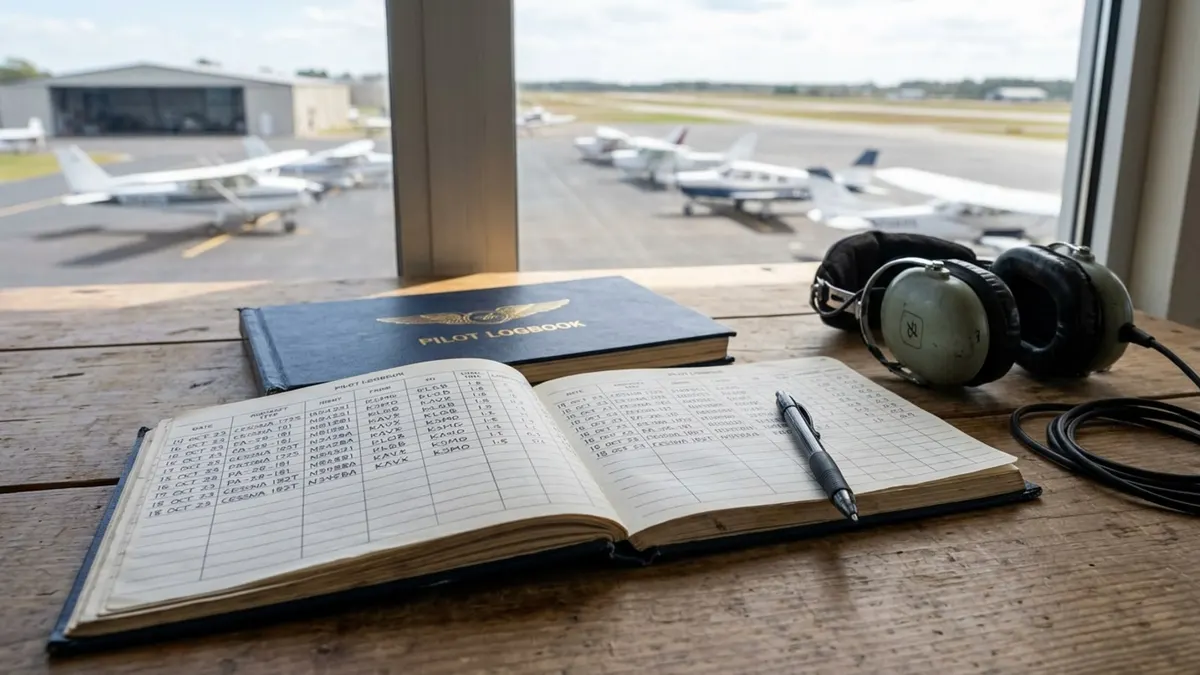
Cover image: Illustration: Aviation Gear Review (AI-generated)
Related guides
Best E6B Flight Computers of 2026: Electronic and Mechanical Picks
Electronic or mechanical? Five E6Bs compared on functions, test use, power and warranty, from ASA's $150 CX-3 to a pocket aluminum slide rule.
Best Flight Bags for Pilots in 2026: Student, GA and Airline Picks
Six pilot bags compared on headset protection, tablet storage, size and organization, from a slim under-seat bag to BrightLine's modular airline system.
Best Foggles and IFR View-Limiting Devices of 2026
Frosted glasses, tinted Blockalls or a hood? What each blocks, how they fit under a headset, and the rules for flying under one.