
Best Foggles and IFR View-Limiting Devices of 2026
The best foggles and IFR view-limiting devices for instrument training and currency: frosted foggles, Blockalls and a hood, plus the safety pilot rules in 91.109.
Affiliate disclosure: product links on this page go to Amazon or to the maker's own store. As an Amazon Associate we earn from qualifying purchases, at no extra cost to you; links to makers' own stores earn us nothing. No retailer or brand sees our picks before they are published or has any say in them. How we choose.
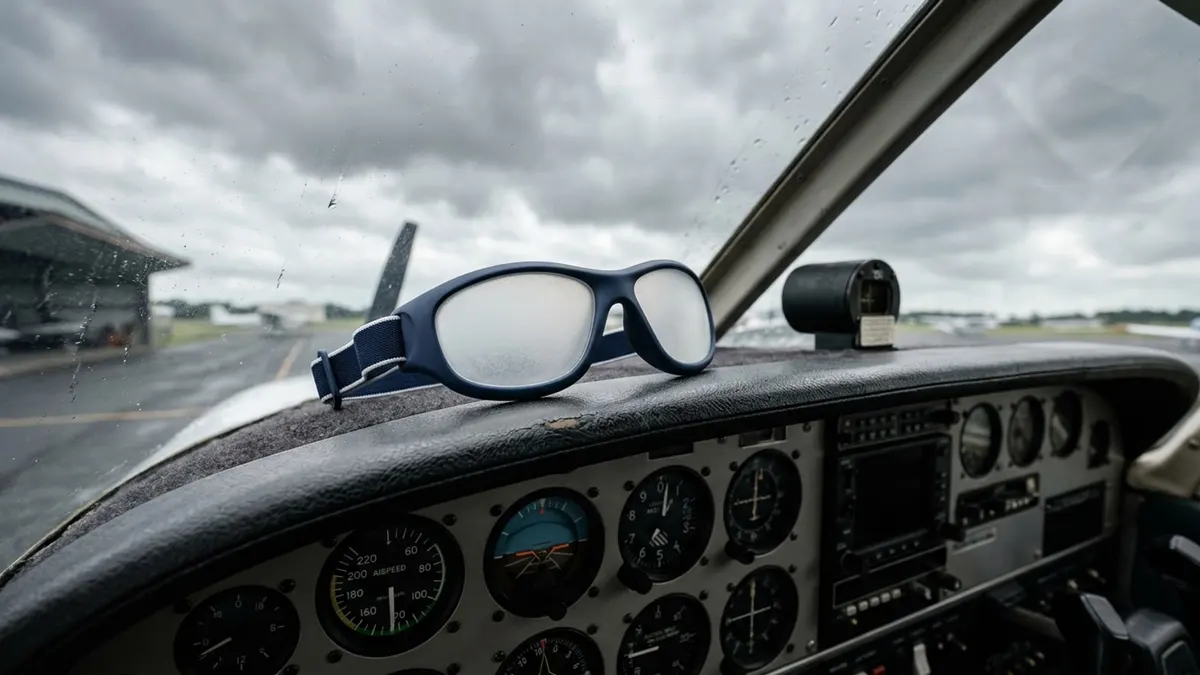
For instrument training and currency flights, a pair of frosted foggles such as Destination Departure's is all most pilots need: frosted polycarbonate lenses blank out the view above the panel while the panel stays clear, slim adjustable temples sit under most headset ear cups, and a neck strap lets you drop them when your instructor says "look up" (per the Amazon listing). If you want sun protection while you practice, Blockalls add a dark tint and weigh under an ounce.
Under 14 CFR 61.57(c), simulated instrument time for currency must be flown "using a view-limiting device," and under 91.109(c) a safety pilot has to occupy the other control seat. The device is cheap; the rules about who sits beside you are not optional.
Our top picks at a glance
1. Best overall
Destination Departure IFR fogglesType: Frosted glasses · Fit with headset: Slim adjustable temples · Extras: Neck strap, soft case · Sold by: The maker
2. Best with sun protection
Blockalls IFR view limiting device (tinted)Type: Tinted view-limiting glasses · Fit with headset: Rubber temple tips · Extras: Dark tint · Sold by: Pilot shop
3. Best with a hard case
Flaperon foggles with hard caseType: Frosted glasses · Fit with headset: Adjustable band · Extras: Hard case · Sold by: The maker
4. Best hood
Super Hood view limiting deviceType: Hood · Fit with headset: Worn over the head · Extras: Fits over glasses · Sold by: Pilot shop
| Pick | Type | Fit with headset | Extras | Sold by | Buy |
|---|---|---|---|---|---|
| Destination Departure IFR fogglesBest overall | Frosted glasses | Slim adjustable temples | Neck strap, soft case | The maker | Amazon |
| Blockalls IFR view limiting device (tinted)Best with sun protection | Tinted view-limiting glasses | Rubber temple tips | Dark tint | Pilot shop | Amazon |
| Flaperon foggles with hard caseBest with a hard case | Frosted glasses | Adjustable band | Hard case | The maker | Amazon |
| Super Hood view limiting deviceBest hood | Hood | Worn over the head | Fits over glasses | Pilot shop | Amazon |
Best overall
Destination Departure IFR foggles
Light frosted foggles with headset-friendly temples, a neck strap and a case.
- Type
- Frosted glasses
- Fit with headset
- Slim adjustable temples
- Extras
- Neck strap, soft case
- Sold by
- The maker
Pros
- Frosted polycarbonate blocks the view outside, panel stays clear
- Neck strap for quick removal
- Light and easy to stow, per the maker
Cons
- No sun protection
- Gaps can let you peek if you tilt your head; your instructor will notice
The listing describes frosted, shatter-resistant polycarbonate lenses that hide the outside view while leaving the instrument panel visible, slim adjustable temples that fit under most headset ear cups, a neck strap and a soft case. The maker also sells a black version with a hard case. These are the simplest way to meet the view-limiting requirement for training and currency.
Best with sun protection
Blockalls IFR view limiting device (tinted)
A tinted view-limiting device for pilots who would otherwise wear sunglasses under foggles.
- Type
- Tinted view-limiting glasses
- Fit with headset
- Rubber temple tips
- Extras
- Dark tint
- Sold by
- Pilot shop
Pros
- Dark tint, so no sunglasses needed (per the listing)
- Under 1 ounce, per the listing
- Rubber nose piece and temple tips
Cons
- Costs more than basic foggles
- Does not fit over prescription glasses
Blockalls take a different approach from frosted foggles: the listing describes a sleek frame with a dark tint, a rubber nose piece and temple tips, and a weight under one ounce. If you fly instrument practice on bright days and find foggles leave you squinting, these combine the view limit and the sunglasses.
Best with a hard case
Flaperon foggles with hard case
Black foggles with an adjustable band and an embossed hard case, for the flight bag.
- Type
- Frosted glasses
- Fit with headset
- Adjustable band
- Extras
- Hard case
- Sold by
- The maker
Pros
- Hard case protects the lenses in a packed bag
- Adjustable band
Cons
- A band can press under some headsets
- No sun protection
Flaperon's black foggles come with an adjustable band and an embossed hard case, per the listing. A hard case matters if your foggles share a bag with a headset and an iPad; scratched frosted lenses are fine, but cracked ones are not.
Best hood
Super Hood view limiting device
A traditional visor-style hood for students whose instructors prefer it, or pilots who wear prescription glasses.
- Type
- Hood
- Fit with headset
- Worn over the head
- Extras
- Fits over glasses
- Sold by
- Pilot shop
Pros
- Works over prescription glasses
- A wide, firm side block
Cons
- Bulkier to stow than foggles
- Can bump the headset and the side window in small cockpits
The hood is the older style of view-limiting device: a visor that blocks the view above and to the sides. It is bulkier than foggles, but it sits over prescription glasses without stacking two frames on your nose.
The rules for flying under a view-limiting device
Who must be in the other seat (14 CFR 91.109(c))
No one may fly simulated instrument flight unless the other control seat is occupied by a safety pilot who holds at least a private pilot certificate with category and class ratings appropriate to the aircraft, has adequate forward and side vision (or a competent observer supplements it), and the aircraft has fully functioning dual controls. A single-engine airplane with a throwover control wheel can qualify only if the safety pilot determines the flight can be conducted safely and the pilot under the hood holds at least a private certificate with the right ratings.
What counts for currency (14 CFR 61.57(c))
To act as pilot in command under IFR, you must have logged, within the six calendar months before the month of the flight, six instrument approaches, holding procedures and tasks, and intercepting and tracking courses through navigational electronic systems. These can be flown in actual conditions or "under simulated conditions using a view-limiting device," or in an approved simulator or training device. If you fall more than six months behind, only an instrument proficiency check restores currency (61.57(d)).
How to log it (14 CFR 61.51)
Log simulated instrument time in its own column and, when 91.109 requires a safety pilot, write the safety pilot's name. Our logbook guide covers the full list of entries.
The safety pilot's side of it
The safety pilot is a required crewmember, because 91.109 requires one. Two things follow from the regulations. First, 61.3(c) says a person may serve as a required pilot flight crewmember only with the appropriate medical certificate, or other documentation acceptable to the FAA, in physical possession or readily accessible in the aircraft; its exceptions are listed in 61.3(c)(2). Second, 61.51(f)(2) lets a pilot log second-in-command time when holding the category and class ratings for the aircraft while more than one pilot is required under the regulations for the flight, which is the case while the other pilot is under the hood. Agree before takeoff who is acting as pilot in command, and log to match.
The currency calendar, worked
| When | Status |
|---|---|
| March 15: you complete six approaches, holding and course tracking | Instrument current |
| Through September 30 | You may act as pilot in command under IFR |
| October 1 to March 31 | Not current. You may fly the tasks again under a view-limiting device with a safety pilot to regain currency |
| From April 1 | More than six calendar months lapsed: only an instrument proficiency check restores currency |
The foggles matter most in the third row. That is when a pair in the flight bag and a friend with a private certificate get you current again for the cost of the flight.
What to write down after each approach
61.51(g)(3) names two things that must be recorded for time used toward instrument currency: the location and type of each instrument approach accomplished, and the name of the safety pilot if one was required. An entry such as "ILS 28R KXYZ, hold at ABC, safety pilot J. Smith" covers it. Without the name, the approaches may not count.
A fit check before the first lesson
Put the foggles on with your headset and, if you wear them, your glasses, in the seat you will fly from. You should see the whole panel, including the lower switch row and the avionics stack, and nothing through the windshield with your head level. If the ear cups lift off the temples and the headset starts to leak noise, try slimmer temples or a hood. Do this on the ground, not on downwind.
Foggles, Blockalls or a hood?
| Type | Blocks | With a headset | With prescription glasses |
|---|---|---|---|
| Frosted foggles | Everything above the panel | Slim temples fit under most ear cups | Awkward; some fit over thin frames |
| Tinted Blockalls | View outside, plus sun | Rubber temple tips | No |
| Hood | Above and to the sides | Sits over the head, can crowd the headset | Yes |
Whichever you choose, the safety pilot does the looking outside. Brief who has which job before takeoff, and agree the words for "look up".
The rest of the instrument kit
An iPad with approach plates on a kneeboard or yoke mount, a portable ADS-B receiver with backup attitude, and a handheld radio round out an instrument student's bag.
Frequently asked questions
Do foggles count for instrument currency?
Yes. 14 CFR 61.57(c) allows the six approaches, holding and course tracking to be flown under simulated conditions using a view-limiting device, with a safety pilot as 91.109(c) requires.
Who can be a safety pilot?
Under 91.109(c), a pilot holding at least a private pilot certificate with category and class ratings appropriate to the aircraft, with adequate vision forward and to each side, in an aircraft with fully functioning dual controls.
Foggles or a hood: which is better?
Foggles are lighter, fit under a headset and stow easily. A hood fits over prescription glasses. Both are view-limiting devices for training and currency.
Can I wear foggles over glasses?
Some foggles fit over thin frames, but many do not. A hood is the simpler choice for pilots who fly in prescription glasses.
Do I have to log the safety pilot's name?
Yes, when 91.109 requires a safety pilot. 14 CFR 61.51(b) lists the safety pilot's name as a required logbook entry in that case.
Sources
- 14 CFR 91.109, Flight instruction; Simulated instrument flight and certain flight tests, Legal Information Institute
- 14 CFR 61.57, Recent flight experience: Pilot in command, Legal Information Institute
- 14 CFR 61.51, Pilot logbooks, Legal Information Institute
- 14 CFR 61.3, Requirement for certificates, ratings, and authorizations, Legal Information Institute
Cover image: Illustration: Aviation Gear Review (AI-generated)
Related guides
Best E6B Flight Computers of 2026: Electronic and Mechanical Picks
Electronic or mechanical? Five E6Bs compared on functions, test use, power and warranty, from ASA's $150 CX-3 to a pocket aluminum slide rule.
Best Flight Bags for Pilots in 2026: Student, GA and Airline Picks
Six pilot bags compared on headset protection, tablet storage, size and organization, from a slim under-seat bag to BrightLine's modular airline system.
Best iPad Kneeboards for Pilots in 2026 (and a Paper One)
Six pilot kneeboards compared on what they hold, how they rotate, how they strap on and their warranties, from a flat magnetic plate to a folio with a stand.